


Key Takeaways
- Rothera is the rebranded MIAX Derivatives Exchange, acquired in January 2026 by a joint venture between Robinhood and Susquehanna International Group, with MIAX retaining 10%.
- The acquisition gave Robinhood a designated contract market and a derivatives clearing organisation, rather than a distribution deal on somebody else's exchange.
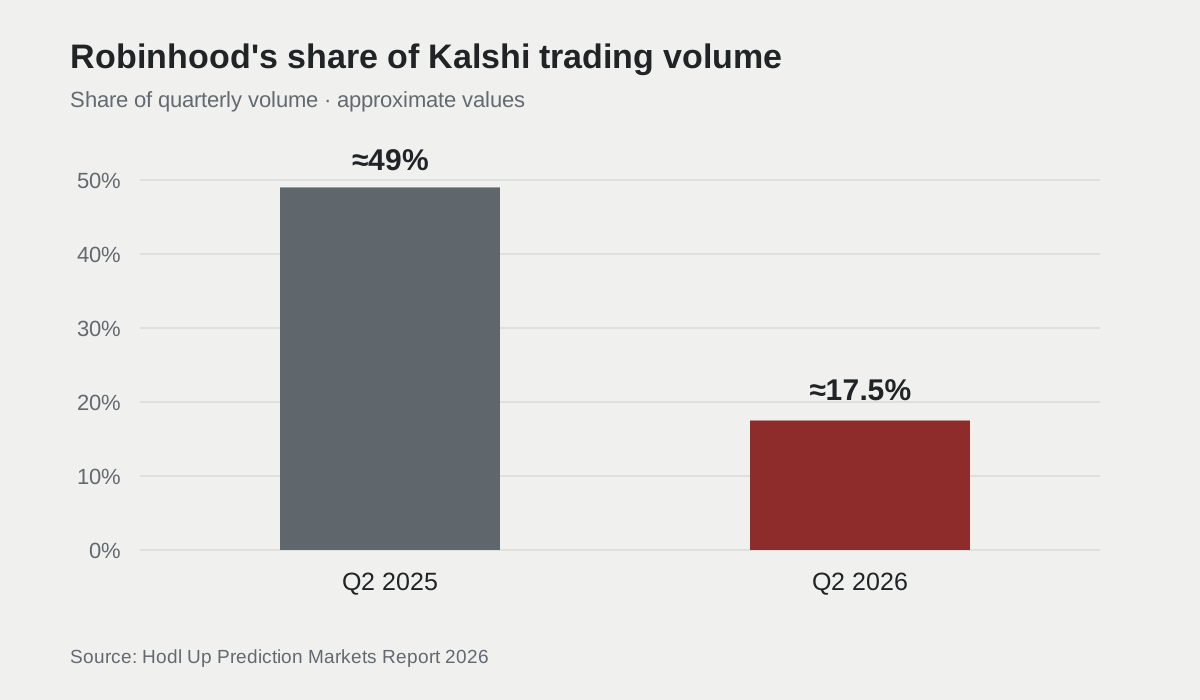
- Robinhood's share of Kalshi's quarterly volume fell from nearly 50% to about 17.5% in a year.
- Event contracts produced $156M of Robinhood revenue in Q2 2026, up more than tenfold year over year, earning more in the quarter than either equities or crypto. Rothera contributed $17M of that in its first partial quarter.
- IG Group ran the same logic in reverse on 30 July 2026, agreeing to buy Underdog for up to $1.3B rather than keep renting access to a US user base.
- The lesson for any venue dependent on a distribution partner is that rented users behave like a moat until the tenant buys the building.
The most consequential 2026 development that coverage missed
Most analysis of prediction markets in 2026 framed the competition as Kalshi against Polymarket. The competitive event that actually reshaped the category was neither. It was the distribution layer, the brokers and apps where the users already are, deciding to stop being partners. Robinhood built its own exchange. IG Group bought one. This piece explains what Rothera is, what the numbers show about the shift, and why it changes how a venue should be valued. The detail comes from the market-structure and unit-economics chapters of the Hodl Up Prediction Markets Report 2026.
What Rothera actually is
On 21 January 2026, Miami International Holdings completed the sale of MIAXdx to a joint venture established by Robinhood Markets in partnership with Susquehanna International Group. The venture acquired 90% and rebranded the exchange as Rothera. MIAX kept 10%.
The structure is what matters. Rothera holds both a designated contract market registration and a derivatives clearing organisation registration, which means Robinhood's joint venture now owns the listing venue and the clearing function rather than routing customer flow to a third party. Live trading started around the turn of June 2026 with World Cup and baseball contracts. Rothera operates as a B2B venue serving futures commission merchants and market makers, so retail users experience it as the Robinhood app while the economics change underneath.
Renting distribution | Owning the venue | |
|---|---|---|
What the broker keeps | A share of the order flow economics | Exchange fees plus clearing fees plus the flow |
Who sets the contract terms | The exchange | The broker's own venue |
Regulatory footprint | Light, the exchange carries it | DCM and DCO obligations, surveillance, capital |
What happens if the partner competes | The broker has no alternative venue | The broker is the alternative venue |
Robinhood's position in 2026 | Until Rothera went live | From June 2026 onward |
The numbers behind the shift
Robinhood ended Q2 2026 with 28.4 million funded customers and reported a record 13.6 billion event contracts traded during the quarter, generating $156M in revenue that the company now discloses as its own transaction-revenue line rather than burying it in "other." Management lists event contracts among thirteen business lines above $100M in annualised revenue. Rothera contributed $17M of the $156M in its first partial quarter.
The more revealing number is what happened to Kalshi. Robinhood fell to about 17.5% of Kalshi's second-quarter volume, from nearly 50% a year earlier. Kalshi's own volume kept growing through that period, so this is a share shift rather than a collapse in demand, and it happened in the space of four quarters.
One caution on the contract figures. Robinhood explicitly warns that its hub count of 13.6 billion and Rothera's 3.5 billion cannot be added, because each counts a different unit. Contract counts are also not notional volume, so neither figure belongs in a comparison against venue dollar volumes.
IG Group ran the same play three weeks later
On 30 July 2026, IG Group agreed to acquire Underdog for up to $1.3B, an upfront enterprise value of about $1.1B equal to 2.4 times Underdog's trailing net revenue of roughly $466M, plus an earnout.
IG was not buying volume. It was buying a vertically integrated licence stack, brokerage plus exchange plus clearing, attached to more than 11 million registered accounts, with over 60% of monthly actives under 30. IG said the deal would lift the US from 22% to about 40% of group revenue and drop its average customer age from about 42 to about 34. Underdog had climbed to third-largest US prediction-market venue by regulated notional flow in under a year, by migrating an existing daily-fantasy user base onto prediction-market rails through the same app, wallet, identity verification and brand.
Both transactions point at the same scarce asset. Licences and users can be bought. The trading take at a single venue cannot be defended on its own once the party supplying the users decides to keep them.
What this changes for valuation
A venue whose volume arrives substantially through a partner is carrying a risk that does not appear in its volume chart. The diligence question the report puts to any operator is direct: what share of volume arrives through a distribution partner, and what happens when that partner builds or buys its own venue? Kalshi answered that question in public over four quarters without choosing to.
It also sharpens where durable value sits. ICE's investment in Polymarket was explicitly about distributing the probability feed as institutional data, which is a claim on the signal rather than the trading take.
For the full market map and the unit-economics tables behind these figures, see the report summary. Venue-level monthly volumes come from The Block's prediction-market dashboard.
None of this is investment advice.